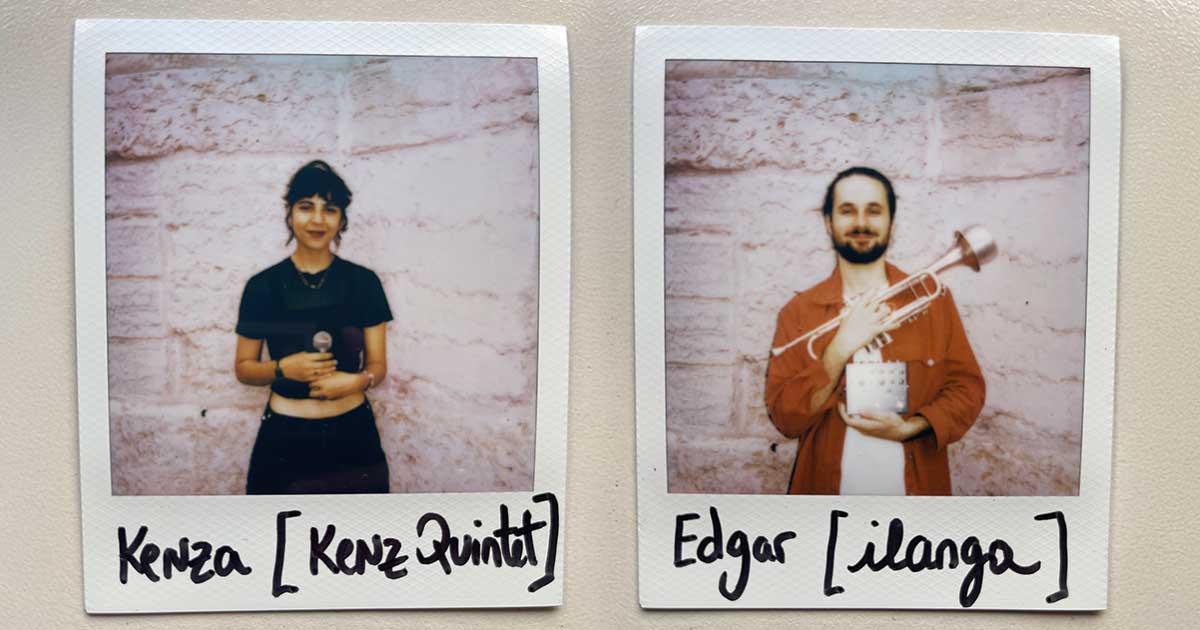
Interview | With Kenza and Edgar: TanDEM 2025/2026 Award Winners
03/07/2026
Throughout the season, Edgar Lepetit and Kenza Taleb were supported by Le Périscope as part of tanDEM, our artist-in-residence program for young instrumentalists. From access to rehearsal studios to stage time, their respective projects—ilanga and Kenz Quintet—were able to develop and mature.
The culmination of their work will be unveiled to the public at Le Périscope on Friday, July 10, at 7 p.m., during a double concert presented as part of our end-of-season festival: Diversions!
As the residency draws to a close, we wanted to sit down with them to reflect on this experience through a few questions.
Can you tell us about your artistic journey?
Edgar: I started making music at around the age of four at the Semur-en-Auxois Music School, where I first discovered the trumpet, then jazz, improvisation, and ensemble playing. I stayed there until I graduated from high school, while also teaching myself electric bass and the oud, and developing a growing interest in jazz-rock, 1970s music, Afrobeat, reggae, dub, and Middle Eastern musical traditions. After high school, I joined the music-study programme at INSA Lyon, which allowed me to pursue engineering studies alongside my musical training. A pivotal encounter with trumpeter Pierre Drevet during a large-scale Brazilian music project in 2019 encouraged me to continue studying jazz trumpet at the ENM in Villeurbanne, where I have been studying since late 2021. Alongside jazz, I have also trained in Cuban percussion, Cuban trumpet repertoire, and, more recently, the traditional music of the Andes.
It was also at INSA that I joined Selil, the band through which I discovered the UK’s nu jazz scene, as well as hip-hop and house music. Between 2020 and 2024, I gradually took on a central role within the band as a composer, booking manager, and contributor to its overall development. During those years, we released three EPs, performed around twenty concerts and festival shows, won first prize at the Campulsations emerging artists competition, and opened for several established acts before the project came to an end at the close of 2024. Since then, I have launched two new projects: Pehoé, and ilanga, a nu jazz quartet built around my original compositions, which I have been leading since January 2026. Alongside my performing career, I was also heavily involved in organising the Un Doua de Jazz festival between 2020 and 2023, first as president and later as co-programmer. That experience continues to fuel my interest in developing musical projects and organising concerts, particularly in rural areas.
Kenza: I feel like I’ve always been singing to myself, whether I was alone or performing for family and friends. Then, when I was about eight years old, my older brother Mamoune bought himself a guitar and suggested we play a few cover songs together just for fun. From that moment on, I kept singing without really questioning it, mostly performing mainstream pop and rock songs. When I was fourteen or fifteen, I took my first singing lessons at a music school in Casablanca, while Mamoune taught me how to write songs and find my way around music production software.
At eighteen, I took a leap of faith and moved to France to study musicology, earning my bachelor’s degree. It was here in Lyon, when I was twenty, that I heard jazz for the very first time. In fact, the first jazz standard I ever listened to and learned was Lullaby of Birdland, introduced to me by Aurèle, the pianist in my quintet.
I joined the Lyon Conservatoire (CRR) in September 2022, and I’ve recently been awarded my DEM (Diplôme d’Études Musicales) in Jazz. It was during my years at the Conservatoire that I realised I wanted to create music reconnecting with my childhood and my roots, blending them with the extraordinary musical language I discovered after arriving in France.
From access to studios to creative time on set, the Périscope program has supported you throughout the season. As this adventure comes to a close, how has this support helped your projects evolve?
Edgar : As the leader of several bands, the programme gave me the opportunity to take part in the Lobsters Workshops. I came away with a solid framework for thinking about and taking action on communication, funding, booking, and production (both live and recorded music), as well as a better understanding of the development challenges I face across my different artistic projects, and even for a possible future non-profit organisation dedicated to promoting concerts in rural areas.
As for the support provided to ilanga, the quartet backed by Le Périscope through the TanDEM programme:
The residencies were really important for the development of our music. They allowed me to work on the band’s sound, record my compositions, and think through the arrangements—especially as we prepared for the live show with Martin (the sound engineer at Le Périscope).
Edgar Lepetit
They also gave me the opportunity to explore the integration of effects into my trumpet playing in greater depth, to reflect on my sound and the configuration of my setup (pedals, microphones, preamp, effects mixing, etc.), and to produce a professional live session—an essential asset for any band.
As for the rehearsal studios, I started using them a little late because I didn’t feel the need at the beginning of the programme. My advice to future TanDEM artists would be to make the most of them, especially if you want to rehearse at weekends and don’t have your own rehearsal space in Lyon.
Finally, I’d like to mention the many conversations I was able to have with members of the Le Périscope team, particularly about the project’s touring strategy and the artistic choices I made for my residency programme.
Kenza: It was thanks to our first residency at Le Périscope in May that the Kenz Quintet really started to take shape and that we began to see the project more clearly. Before then, we’d already made good progress on the compositions themselves, but we were still struggling to picture the set as a whole.
Our first residency allowed us to work through every piece in detail while imagining how each one would fit into the overall shape of the set. It gave us the opportunity to reflect collectively on the details that really make the difference. We’re already looking forward to our final residency in July.
Having access to the studios also enabled us to record a live session, thanks to Martin’s sound engineering and our incredibly talented friends at Bleunami Productions, who came to film us. As a result, we now have a beautiful live session of one of our pieces, “Aji.”
Can you tell us about your various current projects and bands?
Edgar: Right now, I’m working on three music projects that are really close to my heart and have very different musical styles:
ilanga : Formed in early 2026, ilanga brings together Mathieu Salse (electric guitar), Bastien Bethune (drums), Benoît Meyer (double bass), and myself on trumpet, effects, and composition. The repertoire, drawn from my compositions, fuses jazz, hip-hop, and live electronic music. It reflects my love for jazz from the 1960s to the 1980s (modal, fusion, jazz-funk) and for contemporary scenes that are revitalizing jazz, particularly the London scene (Yussef Kamaal, Joe Armon-Jones, Alfa Mist, Oscar Jerome, Nubya Garcia), as well as artists like Christian Scott, Chris Dave, and Léon Phal. In it, I find music that is open, danceable, and vibrant—music that anchors jazz firmly in its time. This project also marks an important milestone in my career, as it allows me to fully embrace a leadership role in composition, artistic direction, and the band’s development.
Pehoé : My South American 70s rock/folk/prog project, launched in 2025 after a formative period spent living in Chile, Peru, Bolivia, and Argentina. We reinterpret the music of Chilean rock bands like Los Jaivas and Los Tres, as well as Chilean Nueva Canción artists such as Victor Jara and Inti-Illimani. I play bass and charango and co-arrange the music.
Herbe à Chats : A trio project focused on live performance and electronic elements, formed in April 2026 (effect-laden trumpet, synthesizers, keyboards, electronic elements, and drums). I compose and play the trumpet with effects on pieces that blend contemporary jazz, reggae, and dub. This project draws heavy inspiration from the solo discography of English pianist Joe Armon-Jones and saxophonist Nubya Garcia, as well as from the sound system culture and the producers and sound engineers of the Jamaican roots and English dub scenes of the 1980s (Jah Shaka, Aswad, Channel One, Twinkle Brothers)…
Kenza: My most active project is actually the “Kenz Quintet,” which I can’t wait to present at the end of our residency on July 10 at the Périscope. The group consists of Nino Montorier (trombone), Aurèle Rallo (piano), Elias Salamo (double bass), Malo Thiery (drums), and myself (composition and vocals). You could describe it as Maghreb jazz, since my influences are clearly jazz and Maghreb music.
Deep down, what I’m really looking to do is make music that comes from the heart, write sincere lyrics, and explore all the facets of my identity and all my influences, alongside extremely talented musicians who are also truly beautiful souls.
Kenza Taleb
I also perform as a duo with Sacha Menneret, a brilliant pianist I met at the conservatory, where we explore jazz from a meditative, evocative perspective, with a message of hope and positivity. We play original compositions as well as covers of songs such as “Starmaker” by Lou Marini and “It’s a New World” by Harold Arlen and Ira Gershwin.
There are other projects taking shape slowly but surely; for now, they’re still in the works, so I’ll talk about them in due time.
How has the residency influenced, shaped, or transformed your creative process?
Edgar: The residencies mainly contributed to the arrangement process in preparation for our live performances, particularly through the discussions I had with the venue’s sound engineer, but also by listening back to the demos we recorded during those sessions, which allowed me to rethink certain aspects of the compositions. Their impact on the creative process itself was more limited, simply because the compositions were already largely finished by the time I began the residency.
Kenza: The residency really helped us move up a gear, in the sense that it gave us the space to reflect on what we genuinely wanted to express in each piece, and to move beyond the compositions as I had originally written them on the page. It allowed us to focus on our collective playing and to develop a real group sound. That was essential because the compositions were still very new, and we hadn’t yet had the time to ask ourselves those important questions that allow the music to truly come alive and take on meaning for everyone in the band.
Was there a particular encounter, a turning point, or a memorable moment that stands out to you from this year at Périscope?
Edgar: The turning point was the final residency at the end of June, when I felt a real sense of excitement within the group as we prepared for the project’s first live performance. It was a moment where we were able to take a step back and look at the nine compositions in our set, which I had written and brought to the band, and everything started to move more quickly. This was especially thanks to the sound engineer, who helped us build the live set in a more efficient, structured, and thoughtful way. There was a collective breakthrough, driven by the feeling of getting a glimpse of what our first concerts would actually look like.
Kenza: I experienced a personal breakthrough in the way I approach my role as a bandleader, and this year at Le Périscope helped me realise the space I wanted to occupy. At the end of the May residency, we had a very meaningful conversation as a group of five that left a strong impression on me. I remember, at the end of that discussion, feeling extremely grateful to have found such a close-knit team, within which I felt safe and able to express myself without fear of being judged or unheard.
There is also one shared experience we all remember: the food experience—Fanny’s cooking is absolutely incredible!
If you could keep only one album (we’re not exclusive to jazz) for the rest of your lives?
Edgar: I’ll answer with one of my recent favourites: All the Quiets, the latest release by English pianist Joe Armon-Jones. It’s a double album in two parts, and I really love the compositions, the sound design, the mixing, and the artist’s universe, which sits somewhere between jazz, dub textures, hip-hop groove, and soul vocals. It’s a world I feel close to, and an album that brings together a lot of what I love in music.
Kenza: There is one album that, over the past five years, has never left me and probably never will—and it’s not jazz: A Moon Shaped Pool by Radiohead. The compositions, the sound work, the arrangements (especially the string arrangements on “Glass Eyes”), the harmonies, Thom Yorke’s voice… It’s an album with no skips that hits me deeply every time I listen to it. A real masterpiece!
Do you have any updates on your upcoming projects to share with us?
Edgar: As for ilanga, the filmed live session will be released soon, and we’re planning an album release based on the recordings from the residencies (and possibly the July 10 live performance). After that, I plan to reach out to Simple Emotion Records and promote ilanga within the “nu jazz” network. The idea is to have ilanga perform in late 2026 and then in 2027, and to quickly start planning a recorded release for the project, in addition to the first releases set to come out in the fall of 2026.
With Pehoé, we’re planning to release a first live session in early July, followed by a live recording in the fall of 2026. As for Herbe à Chats, we recorded our first DIY project in April 2026; a live session and one or two original compositions from it are set to be released between late 2026 and early 2027, alongside several concerts at small venues in Lyon.
Kenza: We recently released the “Aji” Live Session, which we recorded during our residency; you can listen to it now on YouTube. But most importantly, you can come hear us at Le Périscope on July 10. We’ll also be playing with this lineup at the Crescent Jazz Festival on July 16, and then it’ll be time for our summer break—we’ll be back in the fall, ready to unveil some great things for you!
A big thank you to Kenza and Edgar for their answers, their willingness to help, and for sharing their experiences. We wish them all the best and continued success in their musical and professional careers.
As for our TanDEM support program, the next call for applications will be launched in the fall of 2026.