Better Live publishes its White Paper: Rethinking the Mobility of Artists and Audiences
- Pierre Dugelay (director of Le Périscope)
- 14/09/2026
After four years of experimentation and research across Europe, Better Live has published Decarbonising the Artist and Audience Mobility in Music, a white paper devoted to one of the major environmental challenges facing live music: the mobility of artists and audiences.
The results of these four years are substantial: drawing on experiments carried out in nine European territories and comparative research conducted in six countries, the document analyzes the conditions for transforming the sector and puts forward recommendations aimed at public policymakers.
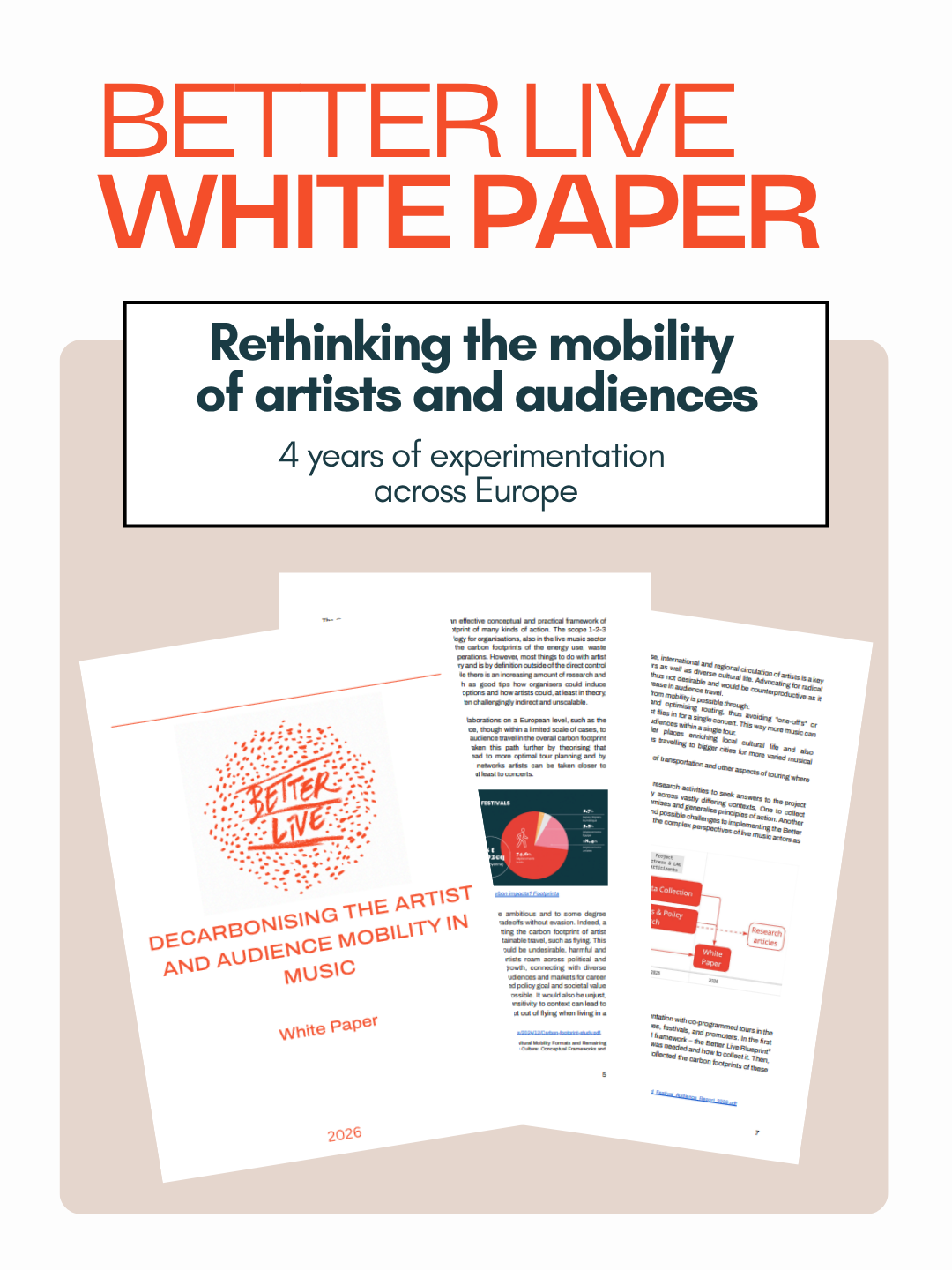
How can the environmental footprint of live music be reduced without giving up the touring of artists, the diversity of programming, and access to music across regions?
That is the question that has occupied the 11 partners of Better Live project since its launch, and it is now the starting point of its white paper, published in July 2026.
Titled Decarbonising the Artist and Audience Mobility in Music, this document of more than 80 pages brings together the results of the experiments carried out during the project, the research conducted in parallel across several European countries, and a series of recommendations addressed to public decision-makers.
The white paper was written by Virgo Sillamaa, research coordinator at EMEE (European Music Exporters Exchange network), who has supported Better Live’s research work since its inception. The research was also carried out by a team including Daniel Nordgård, as well as Liucija Fosseli and Aleksandra Novak from the University of Agder in Norway.
It is the culmination of work begun in 2023 with the creation of the Better Live Blueprint, a conceptual and methodological framework that turned the project’s initial intuitions into hypotheses to be tested, data to be collected, and ultimately, subjects of research.
Better Live: Experimenting before prescribing
Better Live started from an observation that is now widely documented: in the live music sector, the mobility of artists — and even more so, that of audiences — accounts for a major share of an event’s carbon footprint, potentially as much as 80% of its total impact.
At the same time, international and regional mobility remains essential to artists’ careers, to cultural diversity, and to encounters between European scenes. Moreover, moving artists around less can also concentrate cultural offerings and end up increasing audience travel instead.
Better Live therefore worked from a different hypothesis: organize mobility better rather than simply reduce it.
This means longer, better-routed tours; fewer back-and-forth trips and isolated dates; the use of lower-carbon transport wherever the context allows; and, above all, greater cooperation among programmers within the same territory.
It is this principle of co-programming that the project set out to test.
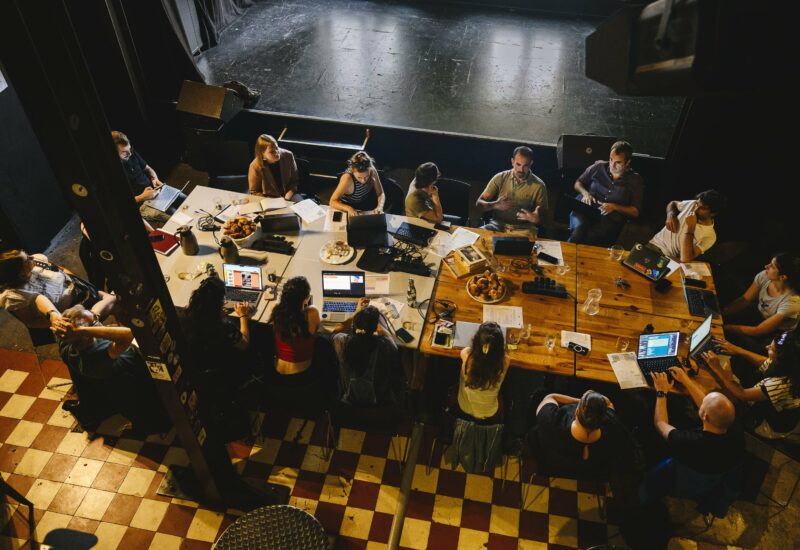
64 Tours, 363 Events, and more than 200 cultural organizations involved
Nine territorial networks — the Local Action Groups — were formed across Europe, bringing together more than 200 music venues, festivals, programmers, and other live-music stakeholders, with the aim of experimenting locally with low-carbon mobility solutions.
In 2024 and 2025, these networks organized 64 tours, comprising 363 artistic events, 223 artists, and 239 venues across 14 different countries.
Events were not limited to concerts: residencies, workshops, meetings, and local outreach activities could also be built into artists’ itineraries.
The principle was fairly simple: when an artist travels from far away, how can that trip be turned into several encounters rather than a single, isolated concert? And how can this circulation be organized at the scale of a territory, rather than leaving each venue to program independently of the others?
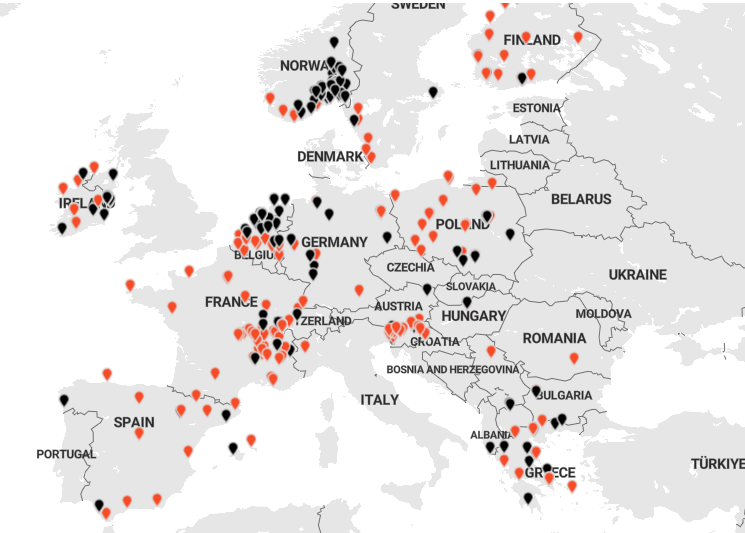
Artist mobility data was collected throughout the tours and fed into a carbon-calculation tool developed for Better Live, based in particular on ADEME’s emission factors. The average footprint of an event was then compared against a reference scenario modeling a “conventional” tour in each territory.
The results are particularly encouraging: across the nine experimental territories, the average carbon footprint per event of Better Live tours is lower than that of the reference scenario representing a “conventional tour.”
The reference scenario refers to the tour a foreign artist would “conventionally” have made in that country, outside the Better Live project. This baseline varies by country and by local programming habits — for example, a single isolated date in Poland for a Spanish artist, or a three-date tour in France for a Norwegian artist. It is this control tour that is compared against the tours tested within the Better Live project in order to measure the reduction in carbon footprint.
The gaps observed between control tours and Better Live tours are significant, with reductions ranging from roughly 35% to 87% depending on the territory.
These figures should nonetheless be read as orders of magnitude rather than absolute measurements. The white paper is explicit about the limitations of the exercise: in the absence of sufficiently precise historical data, Better Live tours are compared against reference scenarios built from partners’ expertise. Each tour, moreover, remains a unique case that is difficult to compare to any other.
Still, the results obtained across very different geographic contexts, combined with the scale of the experiment, are enough to solidly validate the project’s central hypothesis: territorial co-programming, by enabling longer and better-organized tours, reduces the average carbon footprint of artistic mobility per event.
In short: more music for the same amount of travel.
From experimentation to research
The real value of Better Live lay precisely in not stopping at these experiments.
From the project’s inception, a research component was paired with the on-the-ground actions, in order to understand what they could actually demonstrate — but also what conditions would be needed to scale them up.
The research program was thus built around two complementary strands.
The first was based directly on the experimental tours: mobility data, artists’ carbon footprints, audience mobility where data was available, tour organization, and the geographic diversity of programming.
The second shifted the focus to the organization of the sector itself and to public policy: What obstacles do artists, agents, venues, festivals, and programmers face? What environmental policies already exist? How do cultural policies take these issues into account? And, above all, what conditions would allow the practices tested by Better Live to be scaled up more broadly?
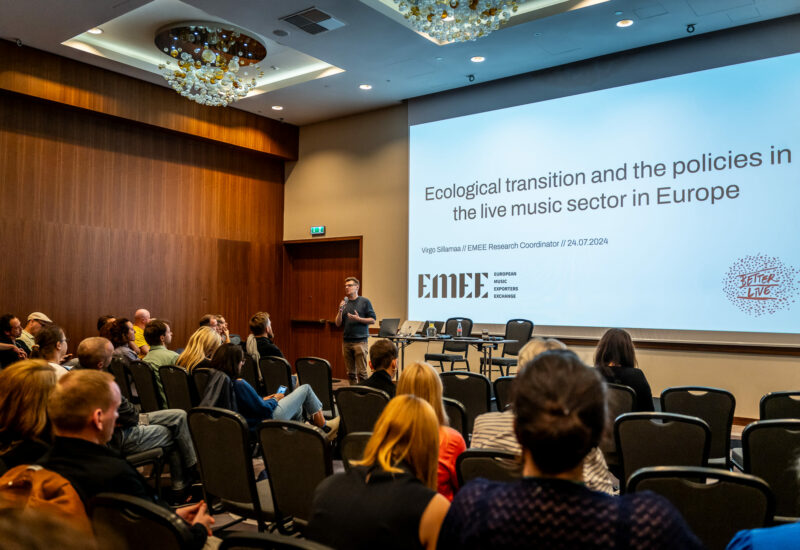
To answer these questions, the research team carried out a comparative analysis across six countries: Finland, France, Ireland, Norway, Poland, and Spain. The analysis drew on a review of existing policies and programs, as well as 20 interviews with 14 public-policy officials and 6 environmental experts.
The white paper thus moves progressively from the field to a much broader reflection on the transformations the sector needs.
Mobility is a collective problem
One of the key findings of the research is that mobility cannot be treated solely as an aggregate of individual behaviors.
A tour is never decided by a single person.
It results from the choices and constraints of an interdependent set of actors: artists, agents, tour managers, producers, and programmers, festivals and venues — compounded by transport infrastructure, economic constraints, and public policy.
The mobility of artists and audiences is therefore a matter of collective action.
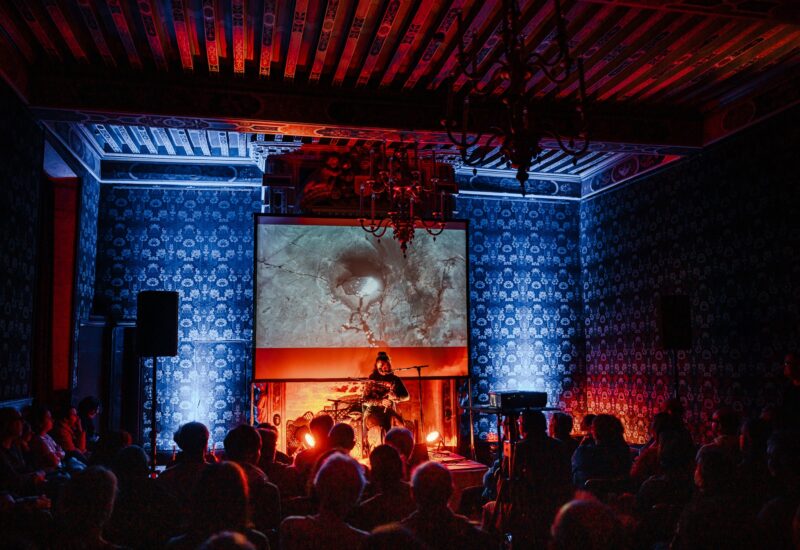
Asking an artist to take the train instead of a plane is not enough if their itinerary spans thousands of kilometers between two concerts. Likewise, asking audiences to leave their cars at home has limited impact in a region with no public transport running after the show.
This approach leads Better Live to advocate for a context-sensitive transition: solutions cannot be identical in a major European rail hub, a rural region, an island country (such as Ireland), or a peripheral country (such as Finland or Greece).
This is also what pushes Better Live’s thinking beyond “slow touring” alone.
The question is no longer simply: how can we travel more slowly, or with lower-carbon transport?
It becomes: how can we organize the circulation of music differently?
Bringing concerts closer to audiences
This white paper also places strong emphasis on audience mobility.
In France, it incorporates the findings of the Landscape study, led by Le Périscope and carried out by The Green Room. Conducted alongside the project, this study is based on around 750,000 ticketing data points from 42 French concert venues.
It reveals a strong relationship between event size and the distances traveled by audiences: the larger the venue capacity, the wider the geographic catchment area.
This observation opens up another avenue: when certain types of mobility are hard to decarbonize — mid-distance car travel in particular — should the goal be solely to transform those trips, or should cultural offerings also be brought closer to where people live?
The white paper thus explicitly raises the following question: should more, smaller-scale events be developed and spread across more territories, rather than systematically pursuing a logic of concentration and ever-larger audience capacities?
This line of thinking gave rise to a formula that has increasingly come to define Better Live, through an advocacy campaign and public communication effort that reached a wide audience: Small is Better.
Not as an absolute principle pitting small events against large ones, but as an invitation to reexamine a live-music economy largely built around growing audience capacities, concentrating crowds, and competition between events.
From results to public policy
Better Live clearly demonstrates that cultural actors can experiment with new ways of working, but they cannot transform the system they operate in on their own.
The final section of the white paper is therefore devoted to an analysis of public policy, leading to a series of recommendations.
The work highlights a notable paradox: in several European countries, cultural actors have developed carbon calculators, roadmaps, and environmental experiments well ahead of public policies having genuinely structured frameworks of their own. Situations, moreover, vary considerably from one country to another.
The white paper therefore calls on public authorities not to simply layer environmental obligations onto existing funding schemes.
Among its key recommendations, it calls for:
- Better measurement of the music sector’s impacts;
- The development of shared, reliable tools;
- Dedicated funding for the ecological transition;
- Adapting requirements to the size and reality of different organizations;
- Better coordination between cultural policy and transition policy;
- Maintaining a network of local venues across every territory;
- Directly supporting the networks that make co-programming possible.
This last point is essential: organizing a tour better takes time, coordination, and human resources. Cooperation among programmers cannot be treated as something that comes for free.
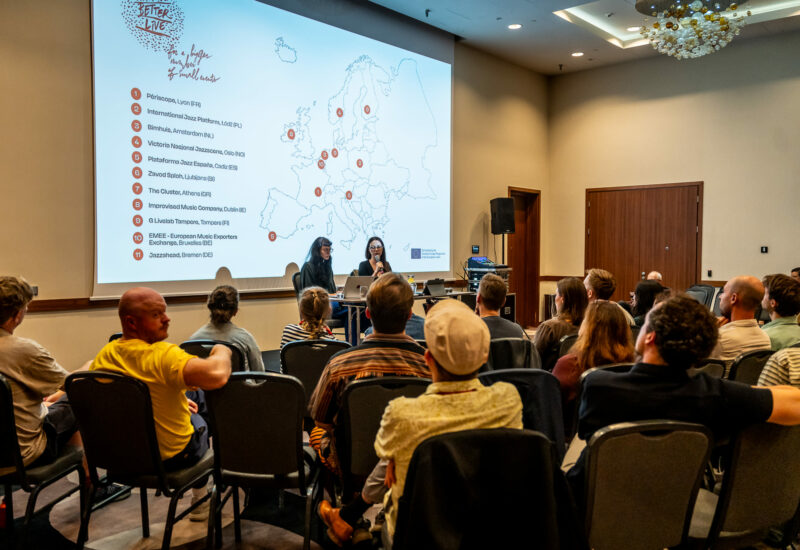
If public policy wants to encourage longer, better-routed, lower-carbon tours, it must also fund actors’ capacity to cooperate.
More broadly, the white paper advocates for an approach in which environmental objectives remain connected to the other priorities of cultural policy: artistic diversity, the economic conditions of organizations and artists, international circulation, access to culture, and territorial balance.
A white paper to open what comes next
Decarbonising the Artist and Audience Mobility in Music does not claim to offer a single model applicable everywhere in Europe.
That is, in fact, one of its conclusions: there is no universal solution to sustainable mobility in live music.
What four years of experimentation and research do provide, however, is a much more precise documentation of the levers available.
- Run longer tours.
- Route them better.
- Cooperate at the territorial level.
- Sustain the international circulation of artists.
- Bring concerts closer to audiences.
- Support a dense network of small and mid-sized venues.
- And give actors the economic and political means to transform their practices.
The white paper thus marks an important milestone for the Better Live project: moving from experimentation to concrete proposals for transforming the sector and its public policies.
Because the question posed at the outset remains, ultimately, wide open: this is not about imagining a music scene that no longer travels in order to reduce its impact.
It is about understanding how it could travel better.
___________
Better Live is a Creative Europe project bringing together 11 partners from the jazz and improvised music scenes across Europe.
Partners includes: INTL Jazz Platform (PL) · Le Périscope – Scène de Musiques Libres (FR) · BIMHUIS(NL) · Nasjonal jazzscene (NO) · Plataforma Jazz España (ES) · Improvised Music Company (IR) · GLive Lab (FI) · EMEE – European Music Exporters Exchange (BE) · Zavod Sploh (SI) · The Cluster (GR) · jazzahead! (DE)