KCIDY
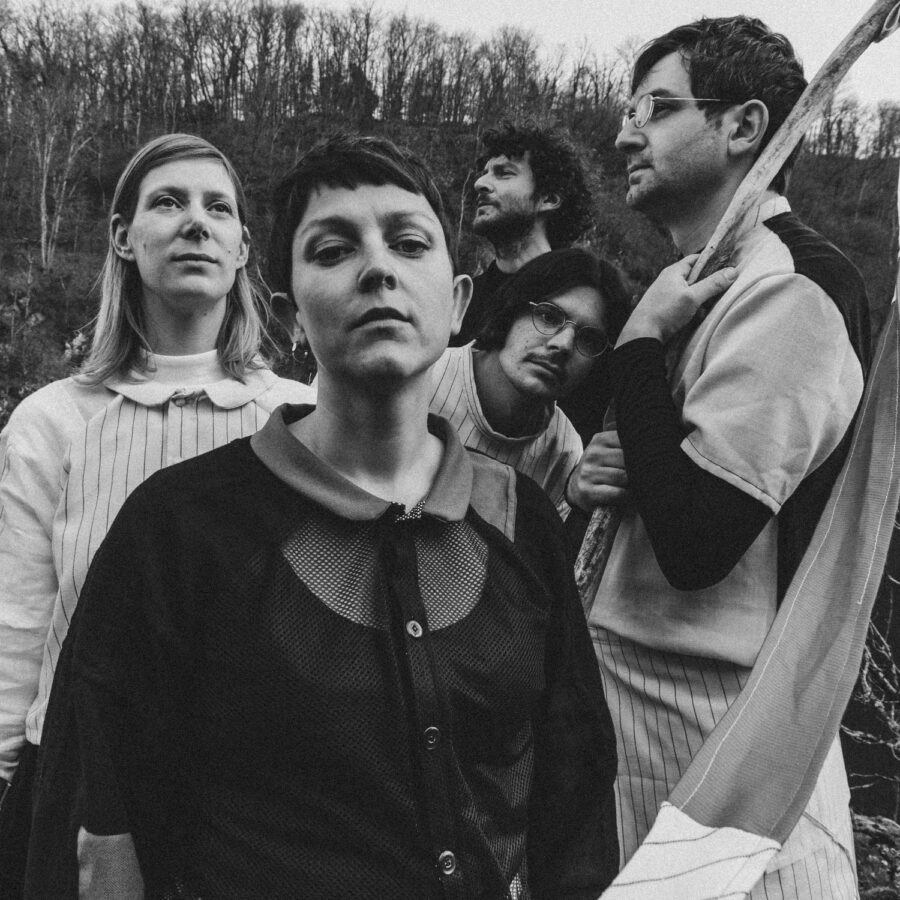
The last time we left KCIDY, KCIDY herself was leaving behind a chapter of her life — the city pace, where nights never end, a narrow perspective opening up with the arrival of her first child. Without regret, she was moving toward a natural light, the one that had always radiated deep within her. Whether by the side of a road, a lake, a field, nestled in a small apartment in Lyon or in a country house, Pauline Le Caignec is constantly composing, and naturally, her pop music reflects all the upheavals she goes through. Since the early 2010s, several chapters have followed: moments in bands like Satellite Jockey or Tôle Froide, her first solo EPs in English, then a shift into French with the 2019 album KCIDY A DIT. Since then, there’s no doubt: her songs are an outlet. Intimate, honest, somewhere between nostalgia and the candid jubilation of everything that makes up the present. It’s her mirror, but not only that — it’s also a playground for adventure, for contemplation, where anything is possible, as long as it creates a shift.
Over time and through her projects, Pauline zooms more and more precisely into her truth — the micro-life and her relationship to all the forces around her. The immensity and the immediate. A good place to begin in order to grasp the essence of KCIDY’s new album, where memories blend with the vertigo of what could be. It is an ode to all the facets of the living world, a window of wonder onto the landscapes that mark her everyday life, those she often seeks out, as well as those dormant in her memory. Confronted with a nature unraveling under human impact, with asphalt swallowing the flora, she feels powerless — and one likes to imagine that through her music, she is trying to preserve what remains of the panorama.
“I wrote these ten songs while looking at these hills, imagining them becoming big, soft mountains, watching birds of prey fly over the meadows, listening to the river flow, impassive yet eager to join the Loire.”
This time, no concept, no packaging — the urgency lies in translating the present. Completed in just a few months, L’immensité et l’immédiat moves quickly and tells without restraint the swarm of reflections from a mind hypersensitive to its surroundings. The album opens with Maisons vides, a tender, amused look back at a childhood tossed about by a dozen moves across France. Over a drumbeat reminiscent of Broadcast’s Come On Let’s Go and deceptively naïve guitar arpeggios, she makes peace with adolescent turmoil. In La mer en hiver, Pauline shares the doubts and questions arising within a couple formed ten years earlier. How do you keep alive the enthusiasm and passion that define the early stages of love? She built the demo alone in her studio, and everything fell into place as naturally as a recipe’s sequence of steps. “I really let myself be carried by the emotion I was experiencing then — both a deep frustration with my partner and a very strong desire for us to reconnect, to love each other even more deeply.”
We dive into a more nocturnal atmosphere with Théorie, its upfront bass line, the melancholy of an electronic organ, and an almost trip-hop drum pattern, supporting chiaroscuro lyrics where lost hope eventually resurfaces. Pauline’s relationship to the world and to sensations becomes clearer in Tu t’ennuieras, a sonic translation of a certain feeling of oppression, of psychological solitude in front of a train she cannot catch. Piano, synthesizer, jungle-inspired drums, electric guitar, orchestral textures — everything is as tense as a one-sided conversation in a therapist’s office. The pace slows with Sujet sensible, a song weighted by the complexities of a mother-daughter relationship struggling to find balance, before shifting into the lightness of Danser sous la pluie, an ode to unexpected storms and pebbles in your shoes that, after all, don’t hurt so much.
The very 60s Comète, where hints of Jacqueline Taïeb and Christine Pilzer can be heard in the sweet audacity of the phrasing, becomes the announcement of an omen, a providential message glimpsed in the sky. She then addresses her friends’ child in Johanna, with its catchy melody, somewhere between glam rock flights and 80s pop song. “I find it very beautiful to take children’s emotions seriously, to speak to them from our adult experience but with the gentleness and tenderness they demand.” L’autre Rive carries something haunting, with a more melancholic atmosphere, close to Radiohead’s aesthetics, a journey toward the unknown, the imaginary, before the mischievous single Poussières, built on layers of addictive synths that seem to speak their own language beneath Pauline’s lyrics. The story ends with a final Ritournelle, its sticky riff, her voice drowned in reverb, humming from afar — as though she were slowly leaving us to dive into the sea, on a Morbihan beach, at the bottom of which lies the world of wonders she never stops wanting to rediscover.
events
Pauline Le Caignec (piano, vocals)
Amélie Lambert (keyboards)
Mathias Chirpaz (guitar)
Rémi Richame (bass)
Florian Adrien (drums)
events